Here is a link to the News Literacy Project page where they have listed many resources and information links. https://newslit.org/ai/?utm_source=gsan&utm_campaign=gsan-mar5-2024a&utm_medium=email&emci=775054f3-11db-ee11-85f9-002248223197&emdi=7d5054f3-11db-ee11-85f9-002248223197&ceid=10134608
Blog
Is That a Fact?
The News Literacy Project has a podcast series called Is That a Fact? The latest one is Season 3, Episode 5: Opinion creep: How facts lost ground in the battle for our attention.
Why Do People Fall For Misinformation?
 | What causes people to fall for misinformation? While the answer is complex, psychologist Lisa Fazio said one reason is because it’s appealing to the brain. False narratives can “provide simple answers for what’s wrong [in the world] and how they can fix it,” she said. Psychologically speaking, a person who has internalized misinformation can correct their beliefs, but it’s difficult — especially if the falsehoods are closely tied to a person’s identity and emotions Fazio said. Examining information, including where it comes from, and taking a pause when a social media post affects emotions are ways to prevent the spread the misinformation. Source: Get Smart About News Jan. 2, 2024 |
Breaking News? Consume with Caution!
“Major news organizations like The Wall Street Journal and The New York Times were publicly criticized following coverage of an Oct. 17 blast at a Gaza hospital complex that killed at least 100 people and possibly hundreds more. Initial reports and news alerts conveyed statements from Palestinian officials who said the blast was caused by an Israeli airstrike. But by the next day both newspapers updated their reporting with statements from U.S. and Israeli government officials who claimed to have evidence that Israel was not responsible for the explosion.”
“A Times spokesman said that during breaking news events “we report what we know as we learn it” and that as facts emerged, they continued reporting. This process was slowed by the fact that the site of the blast wasn’t accessible to journalists and by the amount of time it took Israeli officials to release their findings following the quick statement from the Palestinians. However, given the sensitive nature of the news, a Times editor’s note said “editors should have taken more care with the initial presentation, and been more explicit about what information could be verified.””Major news organizations like The Wall Street Journal and The New York Times were publicly criticized following coverage of an Oct. 17 blast at a Gaza hospital complex that killed at least 100 people and possibly hundreds more. Initial reports and news alerts conveyed statements from Palestinian officials who said the blast was caused by an Israeli airstrike. But by the next day both newspapers updated their reporting with statements from U.S. and Israeli government officials who claimed to have evidence that Israel was not responsible for the explosion.”
“A Times spokesman said that during breaking news events “we report what we know as we learn it” and that as facts emerged, they continued reporting. This process was slowed by the fact that the site of the blast wasn’t accessible to journalists and by the amount of time it took Israeli officials to release their findings following the quick statement from the Palestinians. However, given the sensitive nature of the news, a Times editor’s note said “editors should have taken more care with the initial presentation, and been more explicit about what information could be verified.”
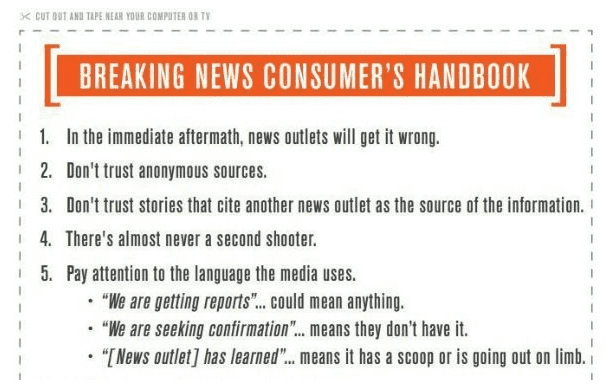
It takes time for journalists to gather enough information about a breaking news event, so slow down and wait for updates and confirming reports from other credible sources before you accept the information as fact.
Source: Get Smart About News<info@newslit.org Oct. 24, 2023
Resource: The Breaking News Consumer’s Handbook
Don’t Let Confirmation Bias Narrow Your Perspective
If we limit our news and opinion information consumption to publications that we agree with, we are looking at the world through myopic lenses and miss many other valid arguments/ideas. As always, look for evidence for any argument/idea and also verify the source as credible. Here is a quick study of confirmation bias that we all have to combat as we react to what we encounter on social media or in the news.
National News Literacy Week
Save the dates! The annual National News Literacy Week (Jan. 23-27) is presented in partnership with The E. W Scripps Company. This year’s NNLW theme is trust: What makes a source of news or information trustworthy or credible? And why is trust important in news consumption? Each day of the week will feature events, resources and engaging discussions. We hope you’ll save the dates — NNLW registrations coming soon!
How to spot manipulated images and videos
To verify an image you find in a news story or social media post, do a reverse image search to see if it has been altered or misrepresented.
Don’t wait for information to be debunked. Learn to “prebunk”.
From: Elizabeth Gilbert from Big Think November 8, 2022
Learn to identify common misinformation techniques with these five videos. The techniques include: 1)emotional language to induce fear, anger or contempt 2)Incoherence like using multiple arguments about the same topic which cannot all be true 3) False dichotomies such as falsely presenting sides or choices as mutually exclusive 4) Scapegoating which is singling out groups or individuals for unwarranted blame 5)Ad hominem attacks that target the person rather than their arguments.
One real world example of prebunking happened when world leaders were warned that Russia would likely use false information to justify their invasion of Ukraine in 2022.
Why Are Political Ads Allowed to Run Misinformation?
David Oxenford, a digital media lawyer said political speech is protected under the first amendment. Then why did some media outlets ban ads they claimed contained untruths? Watch this short video from YouTube.
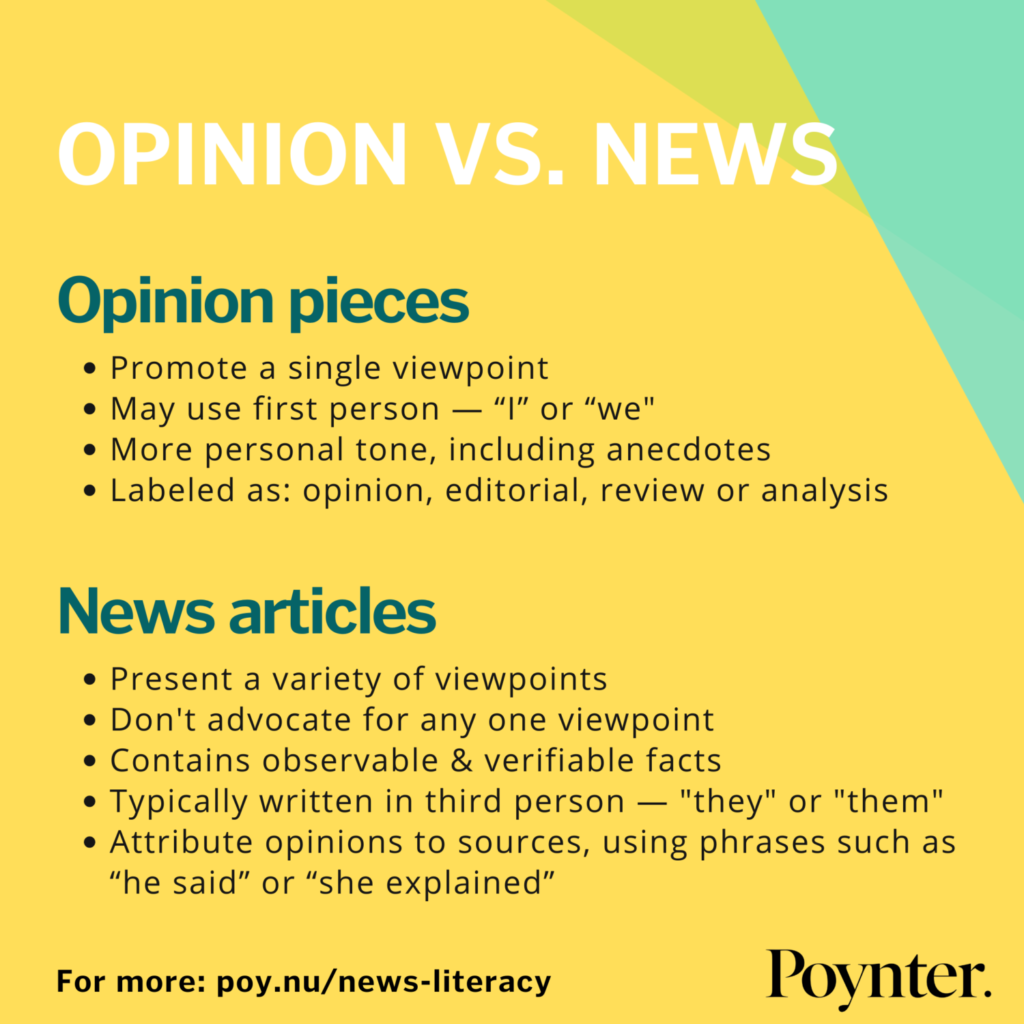
Opinion vs. News